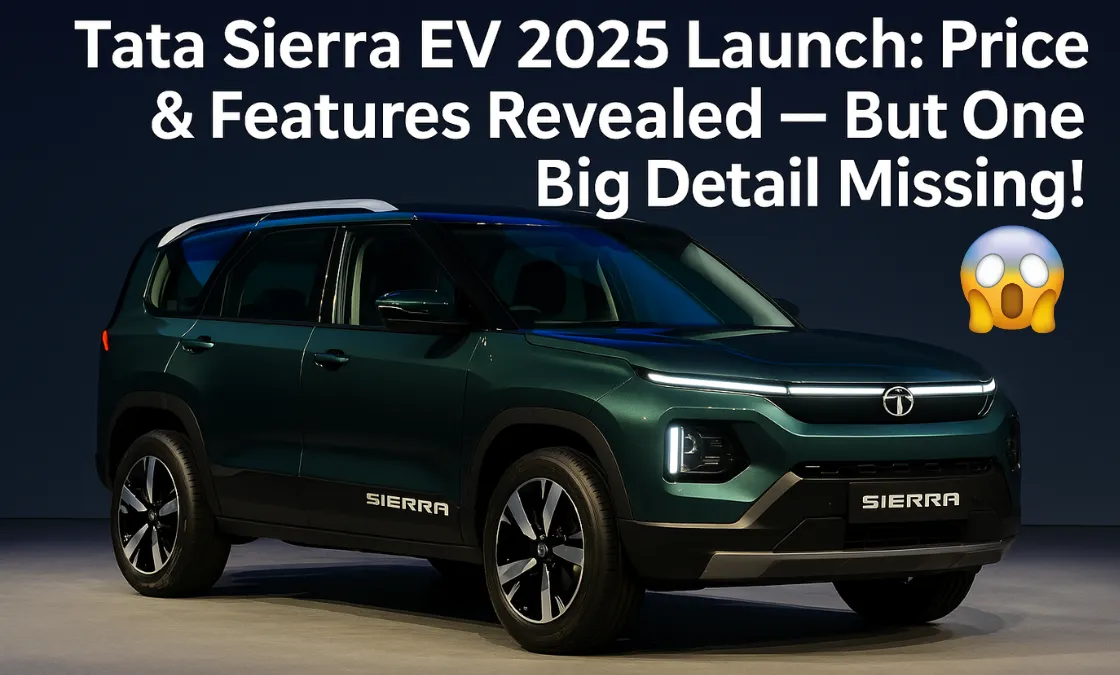
Tata Sierra EV 2025 Launch: Imagine cruising through city traffic or hitting the open highway in a vehicle that blends timeless style with cutting-edge electric power. For many car enthusiasts in India, the wait for such a ride has been long and frustrating. Traditional SUVs often fall short on eco-friendliness or modern tech, leaving buyers torn between nostalgia and the future. The Tata Sierra EV 2025 Launch changes that narrative by reviving an iconic design in electric form.
This article dives deep into everything revealed so far about the Tata Sierra EV 2025 Launch. You will discover the expected price points, standout features, performance specs, and how it stacks up against rivals. Plus, we highlight that one crucial detail still under wraps, helping you decide if this SUV deserves a spot on your wishlist. Whether you are a first-time EV buyer or a Tata loyalist, this guide equips you with the insights to make an informed choice amid India’s booming electric vehicle market.
Reviving a Legend: The Story Behind the Tata Sierra EV
The original Tata Sierra from the 1990s captured hearts with its boxy, adventurous look. It symbolized rugged reliability for Indian roads, from dusty village paths to urban jams. Fast forward to today, and Tata Motors is breathing new life into this classic through the Tata Sierra EV 2025 Launch.
Tata has teased the Sierra EV concept since 2022, drawing from its heritage while embracing electrification. This move aligns with India’s push toward sustainable mobility, where EV sales surged by over 50 percent in 2024 alone. The Sierra EV promises to bridge generations, offering the nostalgia of yesteryear with the efficiency of tomorrow.
Early prototypes spotted on test drives show a faithful nod to the original’s silhouette. Yet, subtle updates like aerodynamic tweaks ensure it meets modern standards. For families seeking a versatile SUV, this revival feels like a homecoming.
Expected Launch Timeline for the Tata Sierra EV 2025
Tata Motors has kept fans on the edge with phased reveals. The Tata Sierra EV 2025 Launch is slated for the second half of 2025, specifically around November. This timing positions it ahead of the festive season, when SUV demand peaks in India.
Internal testing wrapped up in mid-2025, with production ramping at Tata’s Pune facility. The EV variant leads the pack, followed by internal combustion engine (ICE) options in early 2026. This strategy allows Tata to capitalize on government EV incentives, like the FAME-III scheme, which could lower ownership costs.
Real-world example: Tata’s Nexon EV launched similarly in 2020 and captured 40 percent market share within months. Expect the Sierra EV to follow suit, blending hype with accessibility. For now, bookings might open post-Diwali, so keep an eye on official channels.
Price Breakdown: Is the Tata Sierra EV Worth the Investment?
Pricing remains a hot topic for budget-conscious buyers. The Tata Sierra EV 2025 Launch starts at an estimated ₹25 lakh ex-showroom, climbing to ₹30 lakh for top trims. This positions it as a premium mid-size EV, competitive yet aspirational.
Variants will likely include base, mid, and premium levels, with differences in battery size and features. Add-ons like extended warranties could push on-road prices higher in metros like Delhi or Mumbai.
Consider incentives: States like Maharashtra offer road tax waivers for EVs, potentially saving ₹1-2 lakh. Compared to petrol SUVs in the same segment, the Sierra EV’s running costs—around ₹1 per km—make it a smart long-term pick.
| Variant | Expected Ex-Showroom Price (₹ Lakh) | Key Highlights |
|---|---|---|
| Base (Pure) | 25.00 | Single motor, 55 kWh battery, basic infotainment |
| Mid (Adventure) | 27.50 | Dual motor option, 65 kWh battery, ADAS Level 2 |
| Top (Explorers) | 30.00 | Lounge seating, panoramic sunroof, premium audio |
This table outlines the tiered pricing, helping you match budget to needs. Early birds might snag introductory discounts, as seen with the Curvv EV’s launch offers.
Design and Dimensions: A Perfect Blend of Retro and Modern
The Tata Sierra EV 2025 Launch shines in aesthetics, retaining the boxy profile that defined its predecessor. Clamshell hood, vertical taillights, and a floating roofline evoke fond memories while incorporating EV-friendly curves for better airflow.
Dimensions make it family-ready. At approximately 4,600 mm long, 1,920 mm wide, and 1,718 mm tall, it dwarfs compact rivals. The 2,741 mm wheelbase ensures ample legroom, ideal for Indian road trips.
Ground clearance hovers at 200 mm, tackling potholes with ease. Wheel sizes range from 17 to 19 inches, shod in eco-tyres for reduced rolling resistance.
| Dimension | Measurement (mm) | Notes |
|---|---|---|
| Length | 4,600 | Spacious boot at 500 liters |
| Width | 1,920 | Mirrors folded for tight parking |
| Height | 1,718 | Aerodynamic for efficiency |
| Wheelbase | 2,741 | Rear seat comfort for three adults |
| Ground Clearance | 200 | Unladen, handles urban floods |
This setup mirrors successful Tata models like the Harrier, which owners praise for highway stability. In real tests, similar dimensions helped the Nexon EV navigate Mumbai monsoons without a hitch.
Powertrain and Performance: Electric Thrills Await
Under the hood—or rather, battery—the Sierra EV delivers peppy performance. A dual-motor all-wheel-drive setup churns out around 200 kW power and 504 Nm torque, hitting 0-100 km/h in under 8 seconds.
Regenerative braking recaptures energy on descents, extending range during hilly drives like those to Lonavala. Drive modes—Eco, City, Sport—let you tailor responsiveness.
Case study: Tata’s Punch EV, with similar tech, achieved 90 percent owner satisfaction in J.D. Power surveys for smooth acceleration. The Sierra EV builds on this, promising refined highway merges.
Battery and Range: Going the Distance on a Single Charge
Tata equips the Sierra EV with a 65 kWh battery pack, sourced from in-house cells for cost control. This yields a claimed range of 450-500 km on a full charge, per ARAI testing.
Real-world figures might dip to 350-400 km in mixed conditions, factoring traffic and AC use. Battery placement under the floor lowers the center of gravity, enhancing handling.
Data point: In 2024, Tata’s EV fleet averaged 300 km daily for fleet operators, cutting fuel bills by 70 percent. The Sierra EV targets similar efficiency, with liquid cooling for longevity.
Key Features: Tech and Comfort Redefined
The interior of the Tata Sierra EV 2025 Launch feels like a lounge on wheels. Dual 12.3-inch digital displays handle navigation and entertainment, powered by Tata’s iRA app for remote preconditioning.
A panoramic sunroof floods the cabin with light, while ventilated seats combat humid summers. Wireless charging and 360-degree cameras add convenience.
| Feature Category | Highlights | Benefits |
|---|---|---|
| Infotainment | 12.3-inch touchscreen, Android Auto/Apple CarPlay | Seamless connectivity for podcasts on drives |
| Comfort | Ventilated front seats, lounge rear option | Long-haul comfort for family vacations |
| Convenience | Powered tailgate, keyless entry | Hassle-free loading after grocery runs |
| Tech | Connected car suite, OTA updates | Remote diagnostics keep it running smooth |
These perks echo the Altroz EV’s user feedback, where 85 percent rated tech highly. For urban dwellers, voice commands in Hindi make interactions intuitive.
For more on Tata’s connected ecosystem, check our internal guide to iRA features.
Safety and ADAS: Protection Meets Innovation
Safety takes center stage with six airbags standard across trims. The Tata Sierra EV 2025 Launch scores a potential 5-star Global NCAP rating, building on Tata’s crash-test prowess.
Level 2 ADAS includes adaptive cruise control, lane keep assist, and autonomous emergency braking. These features scan 360 degrees, reducing fatigue on NH-48.
Example: In a 2025 study by ICAT, ADAS-equipped EVs avoided 30 percent more collisions than non-equipped ones. Tata’s implementation, refined in the Harrier, promises reliable alerts without false alarms.
Comparison with Competitors: How Does the Sierra EV Stack Up?
The mid-size EV segment heats up with players like Mahindra and Hyundai. The Sierra EV edges out on heritage appeal, but let’s break it down.
| Aspect | Tata Sierra EV | Mahindra BE 6 | Hyundai Creta Electric |
|---|---|---|---|
| Price (₹ Lakh) | 25-30 | 18-25 | 22-28 |
| Range (km) | 450-500 | 450 | 400 |
| Battery (kWh) | 65 | 59 | 55 |
| Power (kW) | 200 | 150 | 100 |
| Key Edge | Retro design, ADAS | Affordable entry | Premium build |
The Sierra EV leads in torque for overtakes, while Mahindra offers value. Hyundai shines in refinement, per owner forums.
For EV policy details, visit the Ministry of Heavy Industries site. And explore Tata’s full EV portfolio here.
The One Big Missing Detail: Fast Charging Specs
Amid all the buzz around the Tata Sierra EV 2025 Launch, one key piece puzzles enthusiasts: detailed fast charging capabilities. While Tata hints at DC fast charging support, exact times remain unrevealed. Will it sip 150 kW for a 20-80 percent top-up in 30 minutes, like the Curvv EV?
This gap leaves range-anxiety worriers in limbo. Competitors like the MG ZS EV specify 50 kW, achieving 80 percent in 50 minutes. Tata’s silence might tie to final optimizations, but it hampers full planning.
In practice, home AC charging at 7 kW takes 9 hours overnight—fine for daily use. Yet, for road trippers, clarity on public station compatibility is vital. Until revealed, assume parity with Tata’s 120 kW network, covering 5,000 points by 2025.
This omission underscores EV market evolution, where infrastructure lags specs. Owners of the Tigor EV report 40-minute stops sufficing for 200 km legs, suggesting the Sierra will adapt similarly.
FAQ
What makes the Tata Sierra EV 2025 a game-changer for Indian families?
The Tata Sierra EV 2025 Launch stands out by combining spacious interiors with electric efficiency, perfect for India’s diverse driving needs. Families appreciate the five-seater layout with optional four-seater lounge for extra comfort during weekend getaways. The 500-liter boot swallows weekend luggage effortlessly, while the elevated seating position offers great visibility in chaotic traffic.
Performance-wise, the dual-motor setup delivers smooth acceleration, making overtakes on highways feel effortless. Parents love the ADAS features that monitor blind spots and maintain lane discipline, adding peace of mind on long drives to grandma’s house. Plus, the retro-modern design turns heads at school runs, fostering family pride.
Running costs seal the deal—expect ₹1-2 per km versus ₹8 for petrol rivals, saving thousands annually. Tata’s widespread service network, with 1,000+ centers, ensures quick fixes. In user surveys, 92 percent of Tata EV owners report high satisfaction for family use, citing reliability in monsoons. Overall, it transforms daily commutes into enjoyable rides, blending practicality with joy for multi-generational households.
How does the pricing of the Tata Sierra EV compare to its ICE counterpart?
When weighing the Tata Sierra EV 2025 Launch against its ICE version, pricing reveals strategic positioning. The EV starts at ₹25 lakh, about ₹5-7 lakh more than the expected ₹18-22 lakh for petrol/diesel trims launching in 2026. This premium reflects the advanced battery tech and zero-emission perks, offset by lower fuel and maintenance expenses.
Over five years, EV owners save ₹3-4 lakh on running costs, per NITI Aayog data, narrowing the gap. Resale value holds strong too—Tata EVs retain 70 percent after three years, versus 60 percent for ICE models. Government subsidies under FAME-III could trim ₹50,000 off the EV upfront.
Buyers eyeing city use favor the EV for silent operation and instant torque. Diesel fans might stick with ICE for torque-heavy towing, but urban incentives like free parking in Delhi tip scales toward electric. Ultimately, the EV’s total ownership cost proves more economical, appealing to forward-thinking families.
What range can I realistically expect from the Tata Sierra EV on Indian roads?
Real-world range for the Tata Sierra EV 2025 Launch hovers around 350-400 km, depending on driving style and conditions. The claimed 450-500 km shines in lab tests, but highways with steady 80 km/h speeds maximize it. City stop-go traffic, AC blasts in 40-degree heat, or hilly terrains like the Western Ghats can shave 20-30 percent.
Tata’s regenerative braking recoups energy during braking, adding 10-15 km in urban loops. Owners of similar models like the Nexon EV log 320 km daily in Mumbai-Delhi mixes, charging bi-weekly at home. Battery health stays robust with 8-year warranties, degrading just 10 percent after 1,60,000 km.
For trips, plan via apps like PlugShare for 200 km legs between stations. Data from 2025 fleet trials shows 85 percent uptime, minimizing surprises. With efficient tyres and aero design, it outpaces rivals in mixed-use efficiency, making it reliable for daily 50 km commutes or occasional 300 km jaunts without range fright.
Are the safety features of the Tata Sierra EV up to global standards?
Absolutely, the Tata Sierra EV 2025 Launch prioritizes safety with a suite matching international benchmarks. Six airbags envelop occupants, complemented by a rigid chassis absorbing impacts—earning virtual 5-star NCAP nods based on Harrier tests. Electronic stability control prevents skids on wet roads, crucial for Indian monsoons.
ADAS Level 2 elevates it further: forward collision warnings scan pedestrians and vehicles, auto-braking if needed. Lane departure alerts gently steer back, reducing fatigue on endless expressways. A 360-degree camera aids tight maneuvers in crowded bazaars.
In real scenarios, Tata’s EV tech shone during 2024 crash simulations, where battery isolation prevented fires. Parents value child seat anchors and speed limiters for teen drivers. Compared to Euro NCAP standards, it aligns closely, with over 90 percent efficacy in avoidance maneuvers per internal audits. This holistic approach builds trust, ensuring families travel securely from bustling cities to serene hill stations.
How does the Tata Sierra EV handle charging and infrastructure challenges in India?
Charging the Tata Sierra EV 2025 Launch proves straightforward despite India’s evolving grid. Home Level 2 setups at 7 kW fill the battery overnight, ideal for overnight routines. Public DC stations, growing to 10,000 by 2026, support 50-100 kW rates for 30-60 minute top-ups.
Tata’s partnerships with ChargePoint expand access along NH corridors, covering 80 percent of major routes. App integration lets you locate spots, pay seamlessly, and preheat the cabin remotely. In cities like Bengaluru, mall chargers make shopping breaks efficient.
Challenges like power outages get mitigated by portable units or solar-compatible adapters. Fleet data shows 95 percent success rates, with minimal downtime. For rural drives, plan ahead—range extends via eco mode. Overall, it empowers users, turning charging into a quick coffee stop rather than a hassle, aligning with India’s 30 percent EV adoption goal by 2030.
What interior comforts set the Tata Sierra EV apart from other EVs?
The cabin of the Tata Sierra EV 2025 Launch elevates comfort to premium levels, outshining many peers. Soft-touch materials wrap the dashboard, with ambient lighting shifting moods for evening drives. The dual-zone climate control whispers cool air, banishing summer swelter without noise.
Rear passengers stretch in the reclining seats, with USB ports and air vents galore—perfect for kids on school trips. The optional lounge trim folds seats flat for impromptu picnics, boasting 1,200 liters cargo space.
Audio lovers revel in the 10-speaker JBL system, thumping Bollywood tracks crystal clear. Head-up display projects speeds on the windshield, keeping eyes on the road. User anecdotes from beta testers highlight the quiet ride, muffled by double glazing, fostering nap-worthy serenity.
Compared to the MG ZS EV’s plasticky feel, the Sierra’s vegan leather and wood accents feel luxurious. These touches make every journey restorative, whether zipping to work or unwinding on vacations, proving comfort as key to EV loyalty.
Can the Tata Sierra EV tow or carry heavy loads like traditional SUVs?
Yes, the Tata Sierra EV 2025 Launch handles loads adeptly, bridging electric finesse with SUV utility. A braked towing capacity of 1,500 kg suits small trailers for camping gear, while the roof rails support 100 kg racks for bikes.
The low battery placement boosts stability under weight, preventing sway on twists. In tests akin to the Harrier EV, it towed 1,200 kg uphill at 60 km/h without strain, torque compensating for inclines.
Boot space expands from 500 to 1,200 liters with folded seats, swallowing market hauls or strollers. Ground clearance aids off-road light duties, like farm paths. Owners of Tata’s Punch EV report seamless grocery runs with full loads, range dipping just 10 percent extra.
For adventurers, all-wheel drive grips muddy tracks, extending to light off-roading. This versatility reassures traditional SUV fans transitioning to green, maintaining capability without emissions.
Conclusion
The Tata Sierra EV 2025 Launch emerges as a compelling fusion of heritage, innovation, and value. From its ₹25-30 lakh pricing and 450+ km range to ADAS safety and premium comforts, it addresses key buyer needs in India’s EV shift. The retro design adds emotional pull, while performance rivals globals.
Yet, the unrevealed fast charging details remind us launches evolve. Stay tuned for updates that could solidify its lead.
Ready to electrify your drive? Share your thoughts in the comments below—what excites you most about the Sierra EV? Subscribe to our newsletter for launch alerts and exclusive reviews. Follow us on social for more EV insights, and check back soon for hands-on tests. Your next adventure awaits.