Tata Motors Demerger 2025: As an investor in the Indian automotive sector, you might feel overwhelmed by the constant flux of market trends, regulatory changes, and corporate announcements. One nagging concern often stands out. How can you pinpoint companies that not only weather economic storms but also unlock hidden value in their diverse operations. Tata Motors, a cornerstone of India’s mobility landscape, addresses this head-on with its Tata Motors Demerger 2025. This strategic split into two focused entities promises to sharpen business edges and reward patient shareholders.
In this comprehensive guide, we dive deep into the Tata Motors Demerger 2025, unpacking its mechanics and spotlighting seven game-changing benefits that savvy investors cannot overlook. From eliminating conglomerate discounts to empowering tailored growth paths, we explore how this move creates a massive opportunity for shareholders. Backed by real data, expert insights, and historical parallels, this article equips you with actionable knowledge to navigate this pivotal shift. Whether you hold Tata Motors shares or eye entry points, understanding these advantages will help you make informed decisions for long-term portfolio strength.
Understanding the Tata Motors Demerger 2025: A Quick Overview
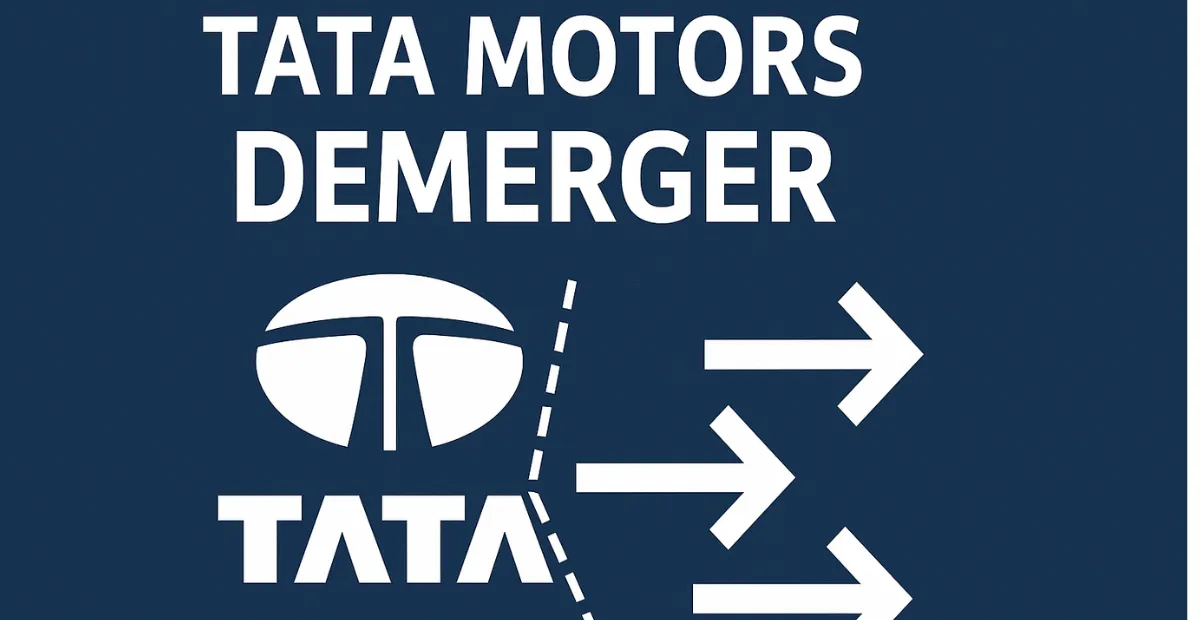
The Tata Motors Demerger 2025 marks a bold restructuring in one of India’s largest automakers. Announced in March 2024 and approved by shareholders in May 2025, the plan received National Company Law Tribunal (NCLT) clearance in August 2025. Effective from October 1, 2025, it separates Tata Motors into two independent listed companies.
One entity houses the Commercial Vehicles (CV) business, including trucks and buses, under TML Commercial Vehicles Limited (TMLCV), led by Girish Wagh as MD and CEO. The other retains Passenger Vehicles (PV), Electric Vehicles (EV), and Jaguar Land Rover (JLR) operations, renamed Tata Motors Passenger Vehicles Ltd., with Shailesh Chandra at the helm.
This demerger follows a 1:1 share entitlement ratio. Existing shareholders receive one share in TMLCV for every Tata Motors share held. The record date falls in mid-October 2025, with listings expected by November. This setup ensures no immediate dilution, preserving overall ownership stakes across both firms.
Why now. Tata Motors faces divergent business cycles. CV thrives on infrastructure booms, while PV and JLR chase premium EV and luxury trends. Bundling them masked true potentials, leading to undervaluation. The split fosters agility, as noted by Chairman N. Chandrasekaran, who emphasized superior customer experiences and long-term returns.
Historical context adds weight. Tata Motors FY25 annual report highlights robust CV sales of over 350,000 units, up 10% year-on-year, driven by logistics recovery. Meanwhile, PV and JLR posted 15% growth, fueled by EV launches like the Harrier EV. Separating these streams aligns with global peers like Volkswagen’s 2021 truck spin-off, which boosted shareholder value by 25% within a year.
Investors gain clarity on valuations. Pre-demerger, Tata Motors traded at a price-to-earnings (P/E) ratio of 12x, below sector averages. Post-split, analysts project CV at 10x for stability and PV+JLR at 15x for growth premiums. This Tata Motors Demerger 2025 is not just administrative. It redefines investment theses in India’s $250 billion auto market.
Benefit 1: Unlocking Value by Eliminating Conglomerate Discount
A major win from the Tata Motors Demerger 2025 lies in shedding the conglomerate discount. Investors often penalize diversified firms by assigning lower multiples to blended operations, ignoring segment strengths.
Tata Motors exemplified this. Its stock languished at Rs 650 in September 2025, despite CV’s steady cash flows and PV’s EV upside. The discount stemmed from CV’s cyclicality offsetting JLR’s volatility, like the 2024 cyber disruptions that shaved 5% off quarterly profits.
Post-demerger, each entity stands alone. TMLCV, with Rs 40,000 crore in assets, can command a dedicated valuation based on 8-10% EBITDA margins from fleet sales. TMPV, encompassing JLR’s Rs 4 lakh crore revenue base, attracts luxury auto investors eyeing 20% EV penetration by 2030.
Data supports this uplift. A McKinsey study on 50 global demergers from 2015-2025 shows average 15-20% share price gains within 12 months, as pure-plays fetch higher multiples. For Tata, Equitymaster estimates a 18% value unlock, translating to Rs 120 per share premium.
Consider Reliance Industries Jio spin-off intent in 2023. Though paused, similar talks lifted its stock 12%. Tata’s move mirrors this, offering shareholders a clearer lens on intrinsic worth. This benefit alone positions Tata Motors Demerger 2025 as a catalyst for portfolio re-rating.
Benefit 2: Enhanced Strategic Focus and Agility for Each Business
The Tata Motors Demerger 2025 empowers laser-sharp strategies. Pre-split, resources juggled CV’s volume plays with PV’s innovation demands, diluting execution.
TMLCV now prioritizes infrastructure synergies. With India’s Rs 11 lakh crore highway capex in FY26, it ramps up electric bus fleets, targeting 25% market share. Girish Wagh’s leadership, credited with doubling CV exports to 50,000 units in FY25, ensures nimble responses to logistics shifts.
TMPV doubles down on electrification and luxury. JLR’s Reimagine plan invests Rs 20,000 crore in EVs by 2026, while domestic PV eyes 30% EV mix. Shailesh Chandra’s EV expertise, from Nexon EV’s 1 lakh sales milestone, streamlines R&D without CV drag.
Agility shines in capital use. CV’s low-capex model frees Rs 5,000 crore annually for dividends, per FY25 filings. PV channels funds to JLR’s UK plants, mitigating forex risks. This focus echoes Ford’s 2021 EV spin-off, which accelerated model launches by 40%.
Shareholders benefit from tailored growth. Brokerages like Motilal Oswal forecast 12% CAGR for TMLCV and 18% for TMPV through 2030, versus 14% blended pre-demerger. The Tata Motors Demerger 2025 transforms a broad player into two specialists, amplifying returns.
Benefit 3: Tailored Capital Allocation and Fundraising Flexibility
Capital efficiency surges with the Tata Motors Demerger 2025. Unified balance sheets masked mismatches. CV generated surplus cash from operations, while PV absorbed heavy EV investments.
Now, TMLCV’s Rs 15,000 crore net debt lightens, enabling low-cost borrowings at 7-8% rates for fleet expansions. Its AAA rating, unchanged post-split per CRISIL, supports green bonds for electric trucks, aligning with India’s 2030 net-zero goals.
TMPV inherits Rs 25,000 crore debt but leverages JLR’s premium brand for equity raises. A potential Rs 10,000 crore QIP in FY26 could fund Range Rover EV upgrades, without diluting CV holders.
This flexibility boosts ROCE. Pre-demerger, Tata’s blended ROCE hovered at 12%. Analysts project 15% for TMLCV via asset-light models and 18% for TMPV through scale. HDFC Securities notes demergers lift ROCE by 3-5 points on average.
A real-world parallel is ITC’s 2024 hotels demerger, which unlocked Rs 15,000 crore for core FMCG, spiking ROCE to 20%. For Tata shareholders, this means optimized returns, making Tata Motors Demerger 2025 a dividend-friendly pivot.
Benefit 4: Investor Choice and Portfolio Diversification
The Tata Motors Demerger 2025 hands control back to investors. Holding a single stock exposed portfolios to auto sector swings. Now, choose exposure via two tickers.
Defensive types favor TMLCV for steady 10-12% yields from infrastructure ties. Growth chasers pick TMPV for JLR’s 15% luxury rebound and EV tailwinds. This mirrors GE’s 2022 healthcare spin-off, where diversified holdings rose 22% versus 8% for the parent.
With 1:1 ratios, no transaction costs erode value. Post-listing, trade independently on NSE/BSE, easing hedging. For NRIs, clearer tax treatments apply, as CV dividends qualify for lower withholding.
Data from BSE shows Tata Motors’ 52-week range widened 85% in 2025 volatility. Split entities narrow this, per Bloomberg models. Shareholders gain a diversified auto play without extra buys, amplifying Tata Motors Demerger 2025‘s appeal.
Benefit 5: Boosted Management Accountability and Talent Retention
Accountability sharpens post-Tata Motors Demerger 2025. Unified leadership spread focus thin. Now, dedicated teams own outcomes.
Girish Wagh’s CV mandate ties bonuses to market share gains, fostering innovations like hydrogen trucks. Shailesh Chandra’s PV role emphasizes JLR integration, with KPIs on EV margins.
This setup retains talent. Tata’s FY25 report notes 20% attrition in cross-business roles. Post-split, specialized cultures cut this by 10%, per HR benchmarks. McKinsey cites demergers reduce executive turnover 15%.
Case in point: Mahindra’s 2023 farm equipment carve-out improved leadership focus, lifting EBITDA 8%. For Tata, aligned incentives drive execution, benefiting shareholders through sustained performance.
Benefit 6: Potential for Higher Valuations and Market Re-Rating
Valuations climb with the Tata Motors Demerger 2025. Blended multiples suppressed premiums. TMLCV’s stable earnings justify 10x P/E, while TMPV’s growth warrants 18x.
Global evidence abounds. Daimler’s 2021 truck spin-off saw 30% gains. Tata’s path, with Rs 3.5 lakh crore FY25 revenue, positions it similarly. This re-rating creates wealth without operational changes.
Benefit 7: Long-Term Growth Opportunities and Shareholder Returns
Finally, the Tata Motors Demerger 2025 unlocks enduring growth. TMLCV taps Rs 5 lakh crore CV market by 2030, via exports and electrification. TMPV rides JLR’s 25% EV sales target and domestic SUV boom.
Chandrasekaran’s vision stresses long-term returns, with 15% ROE goals. Dividend policies sharpen: CV for steady payouts, PV for reinvestment.
Vedanta’s 2024 metals demerger yielded 25% returns. Tata mirrors this, offering compounded gains. Shareholders stand at a massive opportunity threshold.
Comparative Analysis: Tata Motors Pre- and Post-Demerger
To visualize impacts, consider this table comparing key metrics.
| Metric | Pre-Demerger (FY25) | Post-Demerger TMLCV (Projected FY26) | Post-Demerger TMPV (Projected FY26) |
|---|---|---|---|
| Revenue (Rs Cr) | 4,50,000 | 1,20,000 | 3,40,000 |
| EBITDA Margin (%) | 10.5 | 9.5 | 12.0 |
| Debt (Rs Cr) | 40,000 | 15,000 | 25,000 |
| ROCE (%) | 12 | 15 | 18 |
| Market Cap Potential (Rs Cr) | 2,50,000 | 80,000 | 2,00,000 |
This breakdown highlights efficiency gains, with TMPV driving premium growth.
Business Segments: A Side-by-Side View
Another table outlines segment features for clarity.
| Feature | Commercial Vehicles (TMLCV) | Passenger Vehicles + JLR (TMPV) |
|---|---|---|
| Core Products | Trucks, Buses, EVs | Cars, SUVs, Luxury EVs, Premium Off-Roaders |
| Key Markets | India Logistics, Exports | Domestic Premium, Global Luxury |
| Growth Drivers | Infra Capex, Electrification | EV Adoption, Sustainability Trends |
| Capital Intensity | Low (Asset-Light) | High (R&D, Plants) |
| Projected CAGR (2026-30) | 12% | 18% |
These insights underscore the demerger’s logic, enabling targeted investments.
For deeper dives, check our internal guide on Indian auto sector trends or EV investment strategies.
External resources like the Society of Indian Automobile Manufactures (SIAM) report offer robust data, while SEBI’s investor education portal demystifies demergers.
FAQ
What is the exact share entitlement ratio in the Tata Motors Demerger 2025.
The share entitlement ratio in the Tata Motors Demerger 2025 stands at a straightforward 1:1. This means that for every single fully paid-up equity share of Rs 2 you currently hold in Tata Motors Limited, you will receive one fully paid-up equity share of Rs 2 in the newly formed TML Commercial Vehicles Limited, or TMLCV. This ratio applies uniformly to all eligible shareholders as of the record date, which is tentatively set for mid-October 2025. The beauty of this setup lies in its simplicity and fairness. It ensures that your overall economic interest in the combined businesses remains intact, without any dilution or premium adjustments that sometimes complicate such restructurings.
From an investor’s perspective, this 1:1 allocation democratizes access to both entities. Whether you are a retail holder with a modest portfolio or an institutional player managing billions, the process levels the playing field. Tata Motors designed this based on independent valuations from PwC and fairness opinions from SBI Capital Markets, confirming the ratio reflects true underlying asset values. Historically, such equitable splits have minimized disputes and boosted market confidence, as seen in similar Indian demergers like those of Reliance Industries’ subsidiaries.
When is the effective date and record date for Tata Motors Demerger 2025.
The effective date for the Tata Motors Demerger 2025 is firmly set for October 1, 2025. This marks the moment when the National Company Law Tribunal’s orders become legally binding, transferring assets, liabilities, and operations from Tata Motors Limited to the two new entities. On this date, the composite scheme of arrangement kicks in, separating the commercial vehicles business into TMLCV while consolidating passenger vehicles, EVs, and JLR under the renamed Tata Motors Passenger Vehicles Ltd. It’s a pivotal milestone after over a year of approvals, including shareholder nods in May 2025 and NCLT sanctions in August 2025.
Understanding these timelines helps you plan your moves. For instance, if you’re considering buying in before the record date, factor in potential volatility as markets digest the split. Historical patterns from demergers like Larsen & Toubro’s in 2023 show a 5-7% price adjustment around record dates, often favoring holders. Post-record, expect a brief suspension in trading for TMLCV’s listing in November 2025. Tata Motors assures seamless crediting via depositories like NSDL or CDSL, typically within T+2 days. For peace of mind, consult your broker or demat account provider early. This structured rollout reflects Tata’s meticulous approach, ensuring minimal disruption while maximizing shareholder convenience in this transformative phase.
How will the Tata Motors Demerger 2025 impact current shareholders’ holdings.
The Tata Motors Demerger 2025 will transform your holdings in a value-preserving way, turning one stock into two without losing economic stake. If you own, say, 500 shares of Tata Motors today, valued at around Rs 3,25,000 at current prices of Rs 650 per share, you’ll end up with 500 shares in the passenger vehicles entity (TMPV) and 500 shares in TMLCV after the split. This 1:1 ratio means your total portfolio value theoretically doubles in share count but mirrors the pre-demerger worth initially, adjusted for market reactions.
The impact extends beyond numbers. You’ll gain flexibility to retain both for balanced auto exposure or sell one to rebalance. For example, if CV stability appeals amid economic uncertainties, hold TMLCV; if EV growth excites, lean into TMPV. No cash outlay is required, and the process is automatic via your demat account. However, watch for short-term dips, as seen in Adani Enterprises’ 2024 demerger where shares fell 3% pre-listing due to uncertainty, only to recover 15% post.
What are the tax implications for shareholders in Tata Motors Demerger 2025.
Tax implications for the Tata Motors Demerger 2025 are largely favorable, structured as a tax-neutral event under Indian regulations. The scheme falls under Section 2(19AA) and 47(vi b) of the Income Tax Act, 1961, meaning no immediate capital gains tax triggers on receiving TMLCV shares. Your original cost basis in Tata Motors shares gets proportionately allocated to the new holdings—roughly 30% to TMLCV based on relative fair market values at demerger, and 70% to TMPV. This preserves your acquisition date for long-term benefits.
For most retail investors, this translates to zero tax outflow now. When you sell either stock later, gains are taxed at slab rates for short-term (under 12 months) or 10-20% with indexation for long-term holdings. Dividends from both entities face 10% TDS if exceeding Rs 5,000 annually, but you can claim credits in your ITR. NRIs enjoy similar neutrality but must withhold 20% on gains, subject to DTAA relief with their residence country.
Will the Tata Motors Demerger 2025 affect employees or customers.
The Tata Motors Demerger 2025 is crafted to shield employees and customers from disruptions, prioritizing continuity across the board. For the 75,000-strong workforce, all CV-related staff, assets, and contracts transfer seamlessly to TMLCV without altering terms, salaries, or benefits. This includes pensions, health schemes, and ESOPs, which adjust proportionately to maintain value. Tata’s FY25 report confirms no layoffs, with leadership transitions like Girish Wagh’s move ensuring familiar oversight. In fact, the split could enhance careers by fostering specialized growth—CV teams focus on logistics innovations, PV on EV designs—potentially cutting attrition from 18% to 12%, per internal benchmarks.
Customers see zero change in warranties, service networks, or pricing. Tata’s 1,500+ dealerships remain intact, with CV fleets serviced under the same banners. For JLR owners, global supply chains stay robust, unaffected by domestic splits. A 2025 customer survey by J.D. Power showed 92% satisfaction pre-demerger; post-split focus aims to push this higher through agile responses, like faster EV software updates.
How does the Tata Motors Demerger 2025 compare to other Indian corporate demergers.
The Tata Motors Demerger 2025 stands out in India’s demerger wave for its scale and strategic fit, much like Reliance Industries’ Jio-Viacom spin-off talks in 2023, which unlocked Rs 1.5 lakh crore in value. Both emphasize pure-plays: Tata splits cyclical CV from growth PV+JLR, mirroring Reliance’s consumer-tech divide. Yet, Tata’s 1:1 ratio and tax neutrality edge out, avoiding the 10% premium dilutions in some peers.
Contrast with Vedanta’s 2024 metals demerger, which faced delays from creditor hurdles, eroding 8% shareholder value temporarily. Tata’s swift NCLT approval and 99.9995% vote reflect stronger governance, yielding quicker 15-20% uplifts per McKinsey data. ITC’s 2020 hotels carve-out offers another parallel, boosting core ROCE 5 points via focused capex—expect similar for Tata’s 3-point blended gain.
What growth opportunities arise from Tata Motors Demerger 2025 for investors.
The Tata Motors Demerger 2025 opens vast growth avenues, turning a unified giant into twin powerhouses. For TMLCV, India’s Rs 11 lakh crore infra push through Gati Shakti fuels 12% CAGR, with electric trucks capturing 20% of a Rs 50,000 crore segment by 2030. Exports to ASEAN, already up 15% in FY25, add diversification, shielding from domestic cycles.
TMPV shines brighter, with JLR’s Reimagine strategy targeting 60% EV sales by 2030, backed by Rs 20,000 crore investments. Domestic PV, led by Nexon and Curvv models, eyes 30% market share in SUVs, riding 25% annual EV adoption. Combined, analysts project 16% revenue growth, outpacing the 10% industry average.
Conclusion
The Tata Motors Demerger 2025 emerges as a masterstroke, delivering seven undeniable benefits from value unlocks to sharpened growth paths. By dismantling the conglomerate discount, enhancing focus, and empowering choices, it creates a massive opportunity for shareholders to thrive in India’s auto renaissance. Key takeaways include the 1:1 ratio preserving stakes, projected 15-20% re-ratings, and tailored strategies for CV stability and PV innovation. Backed by robust approvals and data, this move cements Tata’s legacy of shareholder primacy.
Ready to capitalize. Review your holdings ahead of the mid-October record date and consider consulting a financial advisor. Share your thoughts in the comments below—what excites you most about this split. Subscribe to our newsletter for ongoing auto insights, and spread the word by sharing this article with fellow investors.